
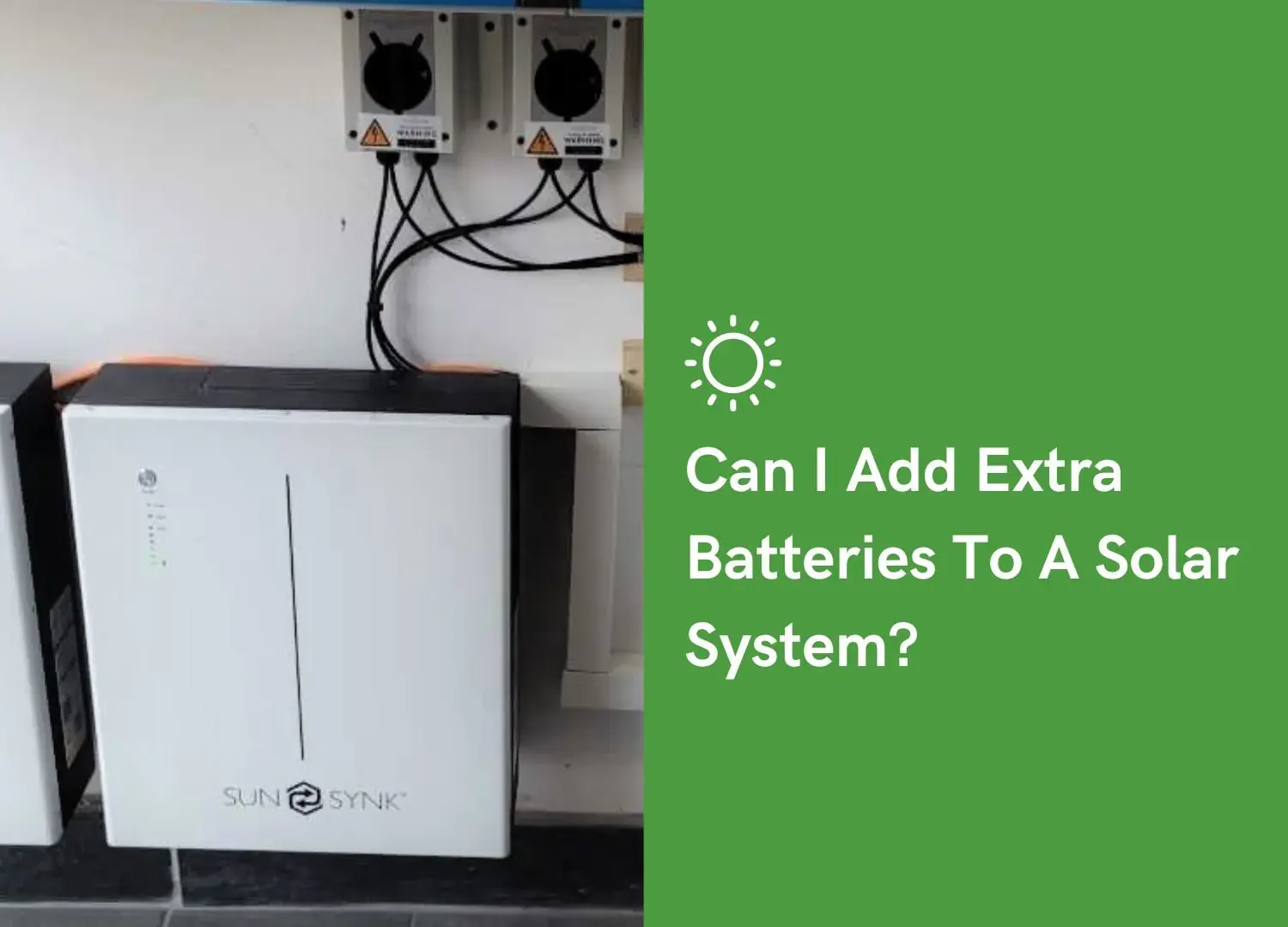
Can You Add More Batteries to Your Solar System?
Yes, in most cases you can. If you have a hybrid inverter and a modular battery, adding another module is usually a half-day job with no new inverter and no work on the roof. The three things that decide it are your inverter's maximum battery capacity, whether your existing battery can be expanded, and how old that battery already is.
For prices by battery type and size, see our solar battery cost guide.
This guide covers both situations: adding storage to solar panels that have never had a battery, and adding more capacity to a battery you already own.
Can you add a battery to existing solar panels?
Yes, and it's one of the most common jobs we do. Plenty of systems fitted before 2020 went in without storage because batteries were expensive at the time. The panels don't need touching, only the electrics.
Most retrofit installations take one to two days. Check your panel warranty before any work starts, because some manufacturers require battery work to be carried out by an approved installer to keep the warranty valid.
There are two ways to do it.
DC-coupled. The battery connects to the DC side of the system, before the inverter. Solar electricity goes straight into the battery as DC with no conversion, which is slightly more efficient. It needs a hybrid inverter, so if you have a plain string inverter it has to be replaced. That costs more up front but leaves you with a tidier, more efficient system and one app for everything.
AC-coupled. The battery has its own built-in inverter and sits alongside your existing setup. Your solar inverter isn't touched. The electricity converts from DC to AC and back again to get into the battery, so you lose a few percent in round-trip efficiency, but the install is simpler and your original inverter warranty stays intact.
| DC-coupled | AC-coupled | |
|---|---|---|
| Needs a hybrid inverter | Yes | No |
| Existing inverter replaced | Usually | No |
| Round-trip efficiency | Slightly higher | Slightly lower |
| Charging from a cheap night tariff | Yes | Yes |
| Best for | Older inverter due for replacement anyway | Newer inverter you want to keep |
Our solar system and battery installation guide walks through the installation itself, step by step.
Can you add more batteries to an existing battery setup?
If your battery is modular, yes. If it's a sealed single unit, you add a second unit alongside it instead.
Modular or stackable batteries are built to grow. The system is a stack of identical modules on a common base, sharing one battery management system, and you add modules up to the maximum the stack and the inverter allow. GivEnergy and Sunsynk systems both work this way. Adding a module is quick, the existing battery keeps its settings, and the whole stack still shows as one battery in the app.
All-in-one and sealed units like the GivEnergy AIO or the Tesla Powerwall 3 can't be opened up and extended. To get more capacity you add a second complete unit, which has to be a model the first one can pair with. That's usually the same product from the same manufacturer.
Either way there are two ceilings to check. The first is the battery system's own maximum stack size. The second is the maximum battery capacity your inverter will manage, which is often the lower of the two.
Will my inverter support extra batteries?
Check three things: the inverter type, its maximum battery capacity, and its firmware.
Inverter type. A hybrid inverter manages solar and battery in one unit and is designed for exactly this. A plain string inverter has no battery management at all, so you either replace it or go AC-coupled. Microinverters are the same situation as a string inverter, so an AC battery alongside is the usual answer. Our solar inverter guide explains the differences in full.
Maximum battery capacity. Every hybrid inverter has a limit on how much storage it will run and how fast it can charge or discharge. That charge and discharge rate matters as much as the kWh number. A big battery behind an undersized inverter fills and empties slowly, so you can't pull enough out of it at teatime when the oven, the kettle and the tumble dryer are all on at once.
Firmware. Manufacturers add new battery models to their approved list through firmware updates. An inverter that's been sitting on the same firmware for four years may not recognise the current version of the battery you already own. A firmware update is part of a decent installer's commissioning routine, not an extra.
We regularly fit and expand GivEnergy, Sunsynk, SolarEdge and Tesla systems. If you're on Sunsynk and want to see what your inverter is set to do before you spend anything, our guide to changing Sunsynk battery settings walks through the charge and discharge options.
Not sure what you've got? The make and model are on a label on the front of the inverter, usually in the loft, garage or utility room. Send us a photo of it and we can tell you what your options are.
Mixing old and new batteries
Match the brand and the model where you possibly can. Mixing creates more problems than the saving is worth.
- Chemistry. Nearly all home batteries sold in the UK now use lithium iron phosphate (LFP), but older units may use a different lithium chemistry with different charge voltages. The two don't share a battery management system happily.
- Age. A three-year-old battery has lost some capacity, and a new module next to it hasn't. In a shared stack the management system tends to work to the weakest module, so your new capacity is partly wasted keeping the old one in step.
- Warranty. This is the one that catches people out. Manufacturers usually void warranty cover on the whole stack if an unapproved unit is added. If the old battery is out of warranty and the new one isn't, you can lose the cover on the new one too.
- Firmware and app. Two brands means two apps, two sets of settings and no single view of what your storage is doing.
If your existing battery is old or discontinued, the honest answer is sometimes that a second separate system, or replacing rather than extending, works out better. A survey establishes which before you commit.
How much does it cost to add another solar battery?
UK market averages run from about £2,500 for 5kWh fitted to around £11,000 for 15kWh, and adding capacity to a system that's already set up for it lands at the lower end, because the inverter, the wiring and the isolators are already in place.
| What you're adding | Suits | Typical UK installed cost |
|---|---|---|
| Around 5 kWh extra (one module) | Covering the evening in a smaller household | £2,500-£4,500 |
| Around 9.5-10 kWh extra | Most of the overnight use in a family home | £4,000-£7,000 |
| Around 13-15 kWh extra | EV charging or a heat pump on top of normal use | £6,000-£11,000 |
| Battery plus hybrid inverter swap | Older string inverter, DC-coupled retrofit | £4,500-£8,500 |
| AC-coupled battery, inverter untouched | Newer inverter you want to keep | £3,000-£7,000 |
Those are market averages rather than our prices, and they come from The Home Energy Hub (£2,500-£4,000 for 5kWh, £4,000-£6,500 for 10kWh), Trade2Base (5kWh £2,500-£4,500, 10kWh £4,000-£7,500, 15kWh £6,000-£11,000) and Lumos Energy (AC-coupled retrofit £2,995-£7,000 for 5-10kWh). Energy Plus puts the hybrid inverter swap itself at £800-£1,500 on top of the battery, which is the gap between the last two rows in the table. Your own quote depends on the brand, the position of the unit and how much electrical work goes with it.
A price should include the battery, the electrical work, commissioning, warranty registration and any DNO notification. When you compare quotes, check all of those are in the number rather than added afterwards.
Worth sorting out at the same time: whether your consumer unit has a spare way, whether the cable run from the battery position to the meter is straightforward, and where the unit will physically sit. A garage, a utility room or a suitable external enclosure are the usual spots. Siting has to follow PAS 63100:2024, the UK fire safety standard for domestic battery storage, which rules out lofts and bedrooms and sets requirements for ventilation and keeping batteries clear of escape routes. Your installer designs the position around that, which is one more reason the survey comes before the quote.
For what a full system costs from scratch, run your details through our solar panel cost calculator.
Is it worth adding more battery storage?
It depends on how much cheap electricity you can actually get into it, and how much expensive electricity you avoid buying as a result.
Time-of-use tariffs are what make a second battery pay. On a tariff with a cheap overnight window you can fill the battery at the off-peak rate and run the house from it through the expensive part of the day, whether the sun shows up or not. The bigger the gap between your off-peak and peak rates, and the more storage you have, the more that's worth. Without a time-of-use tariff, extra capacity only earns its keep on sunny days when you're generating more than you use.
Self-use beats exporting. A unit you use yourself saves you the full rate you'd have paid your supplier. A unit you export earns whatever your Smart Export Guarantee tariff pays, which is normally a good deal less. If your system regularly exports a lot at midday in summer, that's spare generation a bigger battery could be keeping.
Summer and winter are two different stories. In June a 4kW array will often fill a battery by late morning and export all afternoon, which is the case for more storage. In December output is a fraction of that, so the second battery earns its keep through off-peak grid charging rather than solar. See solar panel output by month for the shape of the year.
Where more storage is usually not worth it: a low-usage household that already covers its evenings, a flat export tariff with no cheap overnight window, or a battery that's rarely getting below half charge as it is. Your app will tell you which camp you're in.
How many batteries do I need?
Start from what you use, not from the size of your array.
- Take your annual electricity use in kWh from your bill and divide by 365 to get your daily average.
- Work out roughly how much of that you use when the panels aren't producing, so evenings, nights and early mornings. For most households that's somewhere around half to two thirds.
- That figure, in kWh, is the usable capacity you want.
A home using 3,650 kWh a year averages 10 kWh a day, of which perhaps 5-6 kWh falls outside daylight hours. So 5kWh of usable storage covers most of it, and 9.5kWh gives headroom for winter, guests and an EV.
Two adjustments. Check whether the capacity quoted is usable or total, because depth of discharge means those aren't the same. And if you're on a time-of-use tariff and intend to run the whole house off the battery through the peak period, size to your full daily use rather than just the evening share.
Signs you need more storage
- Your battery is flat by 9pm most evenings and you're back on grid electricity for the rest of the night.
- The app shows steady export through the middle of the day in spring and summer.
- You've added an EV, a heat pump or a hot tub since the battery went in.
- You've moved onto a time-of-use tariff and your cheap overnight window ends before the battery is full.
- Someone in the house has changed their hours and you're now using more electricity in the evening than you were.
- You want backup during a power cut and your current unit only carries the house for an hour or two.
If none of those apply, your storage is probably about right.
Can you charge a battery directly from a solar panel?
Yes, with a charge controller between the panel and the battery. The controller regulates the voltage and stops the battery overcharging. The panel's voltage has to match what the battery needs, and the controller has to be sized for the panel's wattage.
For an off-grid shed or outbuilding, a panel, controller and battery work well without an inverter. On a grid-tied home system, a hybrid inverter does all of this for you.
Looking after your batteries
Lithium-ion batteries need very little hands-on maintenance. Most systems come with an app that shows charge level, cycle count and performance as it happens, so you see a problem straight away rather than months later.
Most inverters and batteries update their firmware automatically over Wi-Fi, but it's worth checking for updates every few months. Keep the battery ventilated and away from direct heat, and have a professional check the system every two to three years to keep it running at full efficiency.
Book a battery upgrade survey
The quickest way to know what your system will take is to have someone look at it.
A CRG Direct battery survey covers your inverter make, model and firmware, its maximum battery capacity, what your existing battery can be expanded to, where a new unit would sit, and what your usage data says you actually need. You get a fixed, itemised price and a straight answer if the honest recommendation is to leave things as they are.
We're MCS certified and NICEIC approved, and we install and service battery storage across the South and South East of England, to MCS and PAS 63100 standards. Call 0330 133 2497, email info@crgdirect.co.uk or book your free survey.
Frequently asked questions
Do I need a new inverter to add a battery?
Not always. If you already have a hybrid inverter with capacity to spare, no. If you have a plain string inverter or microinverters, you either replace it with a hybrid (DC-coupled) or fit an AC-coupled battery that brings its own inverter and leaves the existing one alone. The choice usually comes down to how old your current inverter is.
Can I add a battery to my solar panels myself?
No. Battery installation is notifiable electrical work, it involves DC voltages that are dangerous to work on live, and it has to be notified to your DNO. Doing it yourself puts your MCS certification, your Smart Export Guarantee payments, your manufacturer warranty and very likely your home insurance at risk. It has to be done by a qualified installer, to PAS 63100:2024.
Will adding a battery void my solar panel warranty?
It can if the work is not carried out by an approved installer. Check your panel warranty documents and ask your installer before any work starts.
Does adding a battery affect my SEG payments?
Yes, your SEG income will go down, because you'll be storing and using electricity you used to export. That's normally the better outcome, since a unit you use yourself saves the full rate you'd have paid your supplier, which is higher than most export rates. You stay on your existing SEG tariff, and your installer notifies the change to your supplier as part of the job.
Is there VAT on retrofit solar batteries?
No. Battery storage is zero-rated for VAT in the UK until 31 March 2027, and since 1 February 2024 that includes standalone batteries and batteries retrofitted to an existing system, so you don't lose the relief by adding storage later. After 31 March 2027 the reduced rate of 5% applies unless the government extends it. Source: HMRC guidance on electrical storage batteries and VAT Notice 708/6.
How long do solar batteries last?
Most lithium-ion batteries carry a 10-year warranty and are rated for 4,000 to 6,000 cycles, which is 11 to 16 years of daily use. Many last longer than their warranty.
Sources
- HMRC, VAT on energy-saving materials (zero rate to 31 March 2027): VAT Notice 708/6
- HMRC, electrical storage batteries (zero rate extended to retrofit and standalone batteries from 1 February 2024): VENSAV3061
- Ofgem, Smart Export Guarantee (SEG): official scheme page
- Battery pricing, UK market averages autumn 2026: The Home Energy Hub, Trade2Base, Lumos Energy, Energy Plus, The Cost of Solar