
Ground Mounted Solar Panels UK: Cost & Planning Rules
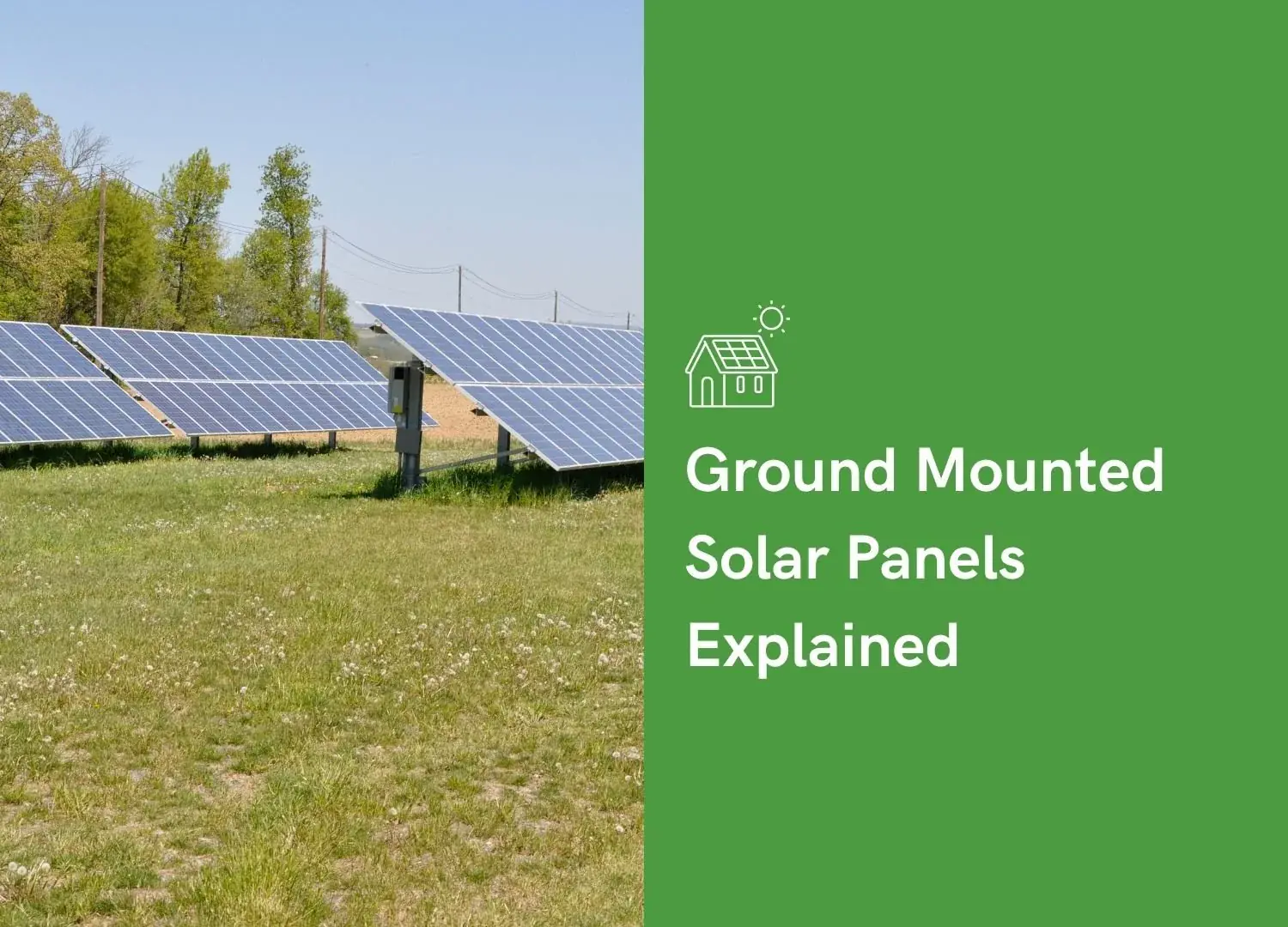
Ground mounted solar panels sit on a frame anchored into the ground rather than fixed to a roof. Same panels, same inverter, same export arrangements. What changes is the cost, the land you need and the paperwork.
One thing catches almost everybody out. In England, a stand-alone solar array is only permitted development if the panel area stays under 9 square metres and no dimension of the array exceeds 3 metres. The 3 metre rule is the one that bites first, and it caps you at two panels. That is roughly 0.8-1.0 kWp, far less than anyone actually wants. Which means almost every ground mounted array worth installing needs planning permission.
This guide covers the rules, what it really costs, and the four situations where ground mounting genuinely beats putting the panels on the roof.
Quick answers
| Question | Short answer |
|---|---|
| Do I need planning permission? | Above 3m in any direction or 9m² of panels, yes. In practice, almost always. |
| How much does it cost? | 15-30% more than the same system on a roof, plus groundwork and trenching. |
| How much land? | Roughly 12-15 m² per kWp, against 5-6 m² of roof. |
| Is it more efficient? | Only if your roof is shaded or badly oriented. Panel for panel, no. |
| Is it worth it for a typical home? | Usually not. It suits high-consumption properties with land and no usable roof. |
| Do trackers help? | Rarely in the UK. More fixed panels give more output per pound. |
What are ground mounted solar panels?
Panels fixed to a metal frame anchored into the ground, rather than bolted to a roof.
The panels, inverter, cabling and export arrangements are the same as any rooftop installation. Only the mounting structure differs. Frames are usually A-frames or driven piles set in concrete, angled at 30-40 degrees and facing south where the site allows.
You'll see them on paddocks, large gardens, farmyards and commercial land, and on properties where the roof is shaded, north-facing or structurally unsuitable.
How do ground mounted solar panels work?
Exactly as rooftop panels do. Sunlight hits the cells, the cells produce direct current, and an inverter converts it to the alternating current your property uses. Our guide to how solar panels work in the UK covers the process in full.
The one meaningful difference is positioning. A roof fixes your angle and direction. The ground doesn't, so an installer can set the frame at the optimal tilt for the site, which matters if your roof would have forced a compromise.
Everything downstream behaves identically. You self-consume what you can, export the surplus under the Smart Export Guarantee, and can add battery storage the same way.
Do I need planning permission for ground mounted solar panels?
In almost every real case, yes.
Stand-alone solar is permitted development in England only within tight limits. The rule that decides it, in Class B of Part 14 of the General Permitted Development Order, is that permission is needed if the panel surface area exceeds 9 square metres or any dimension of the array exceeds 3 metres.
Both limits apply, and the 3 metre one is far more restrictive than the area figure suggests. A modern 400-450W panel measures about 1.76m by 1.13m, so two panels side by side already run 2.26m wide. Add a second row and you're at 3.5m, which is out. Two panels is your lot.
That's around 0.8-1.0 kWp, generating roughly 850 kWh a year in Hampshire. Ofgem's medium household now uses 2,500 kWh of electricity a year, so a permitted development ground array covers about a third of a typical home's use. Nobody digs foundations and lays a cable trench for that. If you want a system worth having, you're making a planning application.
These rules apply to England. Wales, Scotland and Northern Ireland have their own regimes, so check with your local planning authority in every case.
What are the permitted development rules for ground mounted solar?
For stand-alone solar within the grounds of a house or block of flats in England, all of these must be met:
| Rule | Limit |
|---|---|
| Panel surface area | No more than 9 m² |
| Any dimension of the array | No more than 3m |
| Height | No part higher than 4m |
| Distance from boundary | At least 5m |
| Number of installations | Only the first. Any further array needs permission |
| Listed buildings and scheduled monuments | Not permitted within the boundary |
| Conservation areas | If nearer the highway than the house, prior approval needed |
| World Heritage Sites | No part nearer the highway than the nearest part of the house |
Leaseholders should expect to need permission from the freeholder or management company as well, separately from anything the council requires. If you're in a conservation area, read our guide to solar panels in conservation areas before going further.
How big can a ground mounted system be without planning permission?
Two panels. Around 0.8 to 1.0 kWp.
Here's the arithmetic, using a typical 1.76m by 1.13m panel:
| Layout | Overall dimensions | Within 3m? |
|---|---|---|
| Two panels portrait, side by side | 2.26m × 1.76m | Yes |
| Two panels landscape, stacked | 1.76m × 2.26m | Yes |
| Three panels portrait, side by side | 3.39m wide | No |
| Two by two, portrait | 2.26m × 3.52m | No |
| Three panels landscape, stacked | 1.76m × 3.39m | No |
How long does planning permission take?
A householder application typically takes eight weeks from validation, longer if the case officer asks for more information or it goes to committee.
Budget for the application fee, drawings, and possibly a planning consultant. Some installers handle the application and build the cost into the quote, so ask before you assume. Our guide to planning permission for solar panels covers the process for roof systems too.
Refusal is a genuine risk on visible sites, in conservation areas, and where neighbours object on amenity grounds. Don't order equipment before you have a decision.
Do ground mounted solar panels need building regulations approval?
The electrical work does. Your installer notifies it under Part P, and the DNO notification under G98 or G99 applies exactly as it would for a roof system.
The mounting structure itself sits outside building regulations for a typical domestic array, though larger commercial frames may need structural sign-off. An MCS-certified installer handles all of this as part of the job.
How much do ground mounted solar panels cost in the UK?
Expect 15-30% more than the same system on a roof, before groundwork and cable trenching. That's the range we see across the South East. Sunsave puts the premium slightly narrower at 15-20%, which is a fair reflection of straightforward sites.
| System | Roof mounted | Ground mounted, before groundwork |
|---|---|---|
| 4 kWp | £6,000-£8,000 | £6,900-£10,400 |
| 6 kWp | £8,500-£11,000 | £9,800-£14,300 |
| 10 kWp | £14,000-£17,000 | £16,100-£22,100 |
- Groundwork and levelling: £500 to £5,000, depending entirely on the site
- Cable trenching: from around £1,500 for a short run, rising steeply if the array sits far from the house
- Planning application: fee, drawings, and consultant time if you use one
Larger installers quote higher again on bigger arrays. Spirit Energy's published figures, cited by Sunsave, put a 10kWp ground mount at around £27,000 and a 20kWp system at £40,000, which works out at £2,700 and £2,000 per kWp. Compare that to roughly £1,750 per kWp for a domestic roof system and the gap is clear. For rooftop pricing, see how much it costs to install solar panels.
Why do ground mounted systems cost more than roof mounted?
Four reasons, and none of them are the panels.
The frame carries its own load. A roof already exists and already holds itself up. A ground frame has to resist wind uplift on its own, which means deeper foundations, heavier steel and usually concrete.
The groundwork is real construction. Levelling, excavation and concrete pours are labour-intensive and weather-dependent in a way that roof fixing isn't.
The cable run is longer. Every metre between the array and your consumer unit is a metre of trench to dig and DC cable to lay. A spot at the bottom of a two-acre paddock is an expensive place to put panels.
Small systems carry the fixed costs badly. Groundwork, trenching and frame design cost much the same whether you fit six panels or twenty-six. This is why ground mounting has poor economics at domestic scale and much better economics at 10kWp and above.
Is 0% VAT available on ground mounted solar?
Yes. The zero rate on energy-saving materials applies to solar installations at residential properties, ground mounted or otherwise, and runs until 31 March 2027. After that it reverts to 5%.
The relief covers the whole installation contract, including the frame, groundwork, cabling and labour, when supplied as a single job by the installer.
Do ground mounted solar panels qualify for the Smart Export Guarantee?
Yes, on the same terms as rooftop systems. You need an MCS certificate for the installation, a smart meter capable of half-hourly export readings, and a system of 5MW or less.
Typical SEG rates sit around 12p/kWh, with the best open-market flat rates near 20p. Ground arrays are often larger than the property can consume, so your export tariff matters more here than it does for a modest roof system. It's worth comparing the current SEG tariffs before you commit to a supplier.
How much land do ground mounted solar panels need?
Around 12 to 15 square metres of land per kWp, against 5 to 6 square metres of roof for the same capacity.
| System size | Roof space needed | Land needed |
|---|---|---|
| 4 kWp | 20-24 m² | 48-60 m² |
| 6 kWp | 30-36 m² | 72-90 m² |
| 10 kWp | 50-60 m² | 120-150 m² |
| 20 kWp | 100-120 m² | 240-300 m² |
How much space do you need between rows of panels?
Enough that the front row doesn't shade the row behind it in midwinter, when the sun sits lowest.
For a UK array tilted at 35-40 degrees, that generally means a row pitch of roughly two and a half to three times the vertical height of the panels. Tilt the panels more steeply and you gain winter output but need wider spacing. Lay them flatter and you pack more in but lose peak-season yield.
That trade-off is why the land figure is a range rather than a number, and why a proper site layout matters more on the ground than it does on a roof.
Do ground mounted solar panels suffer more from shading?
Usually yes, which surprises people who assume the opposite.
A roof array sits above the fences, hedges and outbuildings that surround a typical garden. A ground array sits among them. Trees, walls, sheds and the house itself all cast shadows across a ground-level site, and those shadows move a long way through the day and across the seasons.
The panels also shade each other if the rows are too tight, which is the one shading problem a roof never has.
Any decent survey models shading across the full year rather than eyeballing it on a sunny afternoon. If an installer won't show you that, get another quote.
Can I put solar panels in my garden?
Yes, subject to the planning rules above.
Two panels, 5m from every boundary, is usually permitted development in England. Anything beyond that needs permission, and a garden array in a small or overlooked plot is exactly the kind of application a council may refuse on amenity grounds.
The practical question is whether you want to give up the space. A 4kWp ground array occupies 48 to 60 square metres, which is a substantial chunk of most gardens, permanently, for 25 years. If the driver is a shaded or awkward main roof, panels on a shed or outbuilding or a wall mounted array may get you there without the groundwork.
Are ground mounted solar panels more efficient than roof panels?
The panels themselves are identical, so no. What differs is how well they can be positioned.
On the ground, an installer chooses tilt and orientation freely. On a roof, the building chooses for you. If your roof faces east-west, or sits at a shallow 15 degree pitch, a ground array set at 35 degrees due south will out-generate it by a meaningful margin.
If your roof already faces south at a sensible pitch, a ground array won't beat it. It'll cost more to achieve the same output.
Do ground mounted solar panels generate more electricity?
Only when the roof was the constraint.
A 4kWp array in Hampshire generates around 3,800 kWh a year facing due south at 35 degrees, whether that's on a roof or on a frame in a field. Move the same array to an east or west-facing roof and output falls around 18%. Face it north and it falls about 40%.
So the honest framing is that ground mounting doesn't add output. It removes a limitation, and only if you had one.
There is one genuine advantage. Ground arrays run slightly cooler than roof arrays, because air circulates on both sides. Panels lose efficiency as they heat up, so a well-ventilated ground array can edge ahead by a couple of percent in high summer.
Should you use bifacial panels on a ground mount?
This is the one domestic setting where bifacial panels are an easy recommendation.
A bifacial module generates from its rear face as well as its front, using light reflected off the ground beneath the array. A frame lifts the panels well clear of the surface and sets them at a proper tilt, which is exactly the geometry the rear face needs. Over grass or soil, expect roughly 5-10% extra annual generation. Over light gravel or concrete, 10-15% and upwards.
That also changes how you treat the ground under the array. Laying light-coloured gravel rather than letting grass grow protects the gain, and long vegetation costs you more with bifacial panels than with standard ones.
The trade-offs are weight, since glass-glass modules are heavier and the frame has to allow for it, and string design, since the extra current from the rear face has to be accounted for by the installer. Our bifacial solar panels guide sets out the numbers by surface type.
Can ground mounted solar panels use tracking systems?
Yes. A tracker moves the panels through the day to follow the sun, and it can only realistically be fitted to a ground mount, since domestic roofs can't carry the weight or the moving load.
Single-axis trackers follow the sun east to west. Dual-axis trackers also adjust for seasonal height. Both are common on solar farms and rare on domestic installations in the UK.
Are solar trackers worth it in the UK?
Rarely. The money almost always goes further on more fixed panels.
Trackers claim output gains of up to 40%, but that figure comes from sunny climates with strong direct sunlight. UK conditions are heavily diffuse, and diffuse light arrives from the whole sky regardless of where the panel points, so real-world UK gains land closer to 20-30%.
Run the comparison on a 4kWp array generating 3,800 kWh a year, where the frame and groundwork are already being paid for either way:
| £3,000 spent on | Extra annual output |
|---|---|
| A tracker adding 25% | +950 kWh |
| More fixed panels at £1,750/kWp | +1,629 kWh |
Trackers make sense when land is constrained and capital isn't, which describes very few domestic sites.
Are ground mounted solar panels worth it for a home?
For most UK homes, no. Roof mounting is cheaper, simpler and needs no planning application.
The case against for a typical household is straightforward. You pay 15-30% more before groundwork. You give up 50 to 150 square metres of garden. You need planning permission for anything above two panels. And you get no extra generation for the money unless your roof was the problem in the first place.
The industry rule of thumb is that ground mounting starts to justify itself at around 10kWp of capacity and 10,000 kWh of annual consumption. Ofgem's medium household uses 2,500 kWh, so most homes fall a long way short. Before you go any further, get an honest answer on whether your roof is suitable for solar.
When do ground mounted solar panels make sense?
Four situations, and they're all real:
- You have no usable roof. North-facing, heavily shaded, structurally unsound, listed, or simply too small. If the roof is out, the ground is the only option.
- You use a lot of electricity and have land. A property drawing 10,000 kWh or more a year, with a paddock or unused field, can install the 10kWp-plus system that makes the groundwork worth paying for.
- You're a farm or commercial site. Large daytime loads, plenty of land, and roofs that are often unsuitable or already in use.
- You're already doing groundworks. If there's an excavator on site for something else, the marginal cost of a ground array drops sharply.
If none of those describe you, put the panels on the roof.
Are ground mounted solar panels good for farms and commercial sites?
This is the strongest case for the technology.
Commercial and agricultural properties tend to consume most of their electricity between 9 and 5, which is exactly when the array is generating. Self-consumption rates of 70-80% without a battery are common, against 40% for a typical home. That alone changes the economics.
They also have the land, and often roofs that are asbestos, north-lit or already carrying plant.
A 10kWp ground array in Hampshire generates around 9,500 kWh a year. On a site self-consuming 70% of that, most of the generation displaces electricity you'd otherwise buy at your contracted import rate, and the remainder earns whatever your export tariff pays. Business tariffs sit outside the domestic price cap and vary widely between sites and contract dates, so the value of an array to your business depends on your own usage, generation and energy costs. Ask for a written estimate modelled against your actual half-hourly consumption data rather than a generic figure. Our guide to commercial solar PV goes into the business case in more depth.
Do solar farms use ground mounted systems?
Almost all of them. Large open sites let developers install thousands of panels at optimal tilt and orientation, and trackers become worthwhile at that scale.
The technology is the same as a domestic array. Only the scale, the grid connection and the planning regime differ. Utility-scale schemes go through full planning, and the largest fall under the Nationally Significant Infrastructure Projects process rather than the local authority.
How much maintenance do ground mounted solar panels need?
Very little, and slightly less awkward than a roof array, though the difference is smaller than people expect.
Panels are self-cleaning in UK rainfall at any tilt above 15 degrees, and a proper clean is needed every two or three years at most. Being at ground level does make that easier and cheaper.
Ground arrays bring two jobs a roof doesn't. Keeping vegetation cut back so grass and brambles don't shade the bottom row, and an occasional check on frame fixings and ground anchors after high winds.
The components most likely to need attention, the inverter and any battery, live indoors or on a wall either way.
Are ground mounted panels more vulnerable to theft or damage?
They're more accessible, which cuts both ways.
At ground level, panels are reachable by people, livestock, footballs and mowers in a way roof panels aren't. Rural sites with road frontage are the main concern. Anti-theft fixings, fencing and adding the array to your buildings insurance are all worth discussing at survey stage.
Tell your insurer either way. A ground array is a substantial permanent structure and most policies expect to be told about it.
How long do ground mounted solar panels last?
The panels carry the same 25-year performance warranties as rooftop panels, typically guaranteeing 80-82% of rated output at year 25, and many keep generating past 30. Our guide to how long solar panels last covers degradation rates in detail.
Galvanised steel frames are rated for decades and generally outlast the panels they carry. The inverter is the shortest-lived major component, typically needing replacement somewhere around year 12 at a UK market average of £650-£1,100 fitted for a like-for-like string unit.
One practical advantage of a ground mount: replacing panels or an inverter at end of life needs no scaffolding, which takes real money off any future upgrade.
What is the environmental impact of ground mounted solar?
Low in operation, and land use is the main consideration rather than emissions.
A domestic system offsets around one tonne of CO2 a year, and the carbon embodied in manufacturing is typically repaid within one to three years of generation.
The land question is genuine at scale. Panels occupy ground that could otherwise be grazing, growing or habitat. Well-designed sites now graze sheep between rows and plant wildflower margins, which recovers much of the biodiversity value. For a domestic array on an unused corner of a garden, the footprint is trivial.
What should I check before getting a quote?
Five things, in this order:
- Whether your roof genuinely won't work. Get that assessed first. If the roof is viable, the ground question usually answers itself.
- Your annual electricity consumption in kWh. Below about 6,000 kWh, ground mounting is hard to justify.
- How far the array will sit from your consumer unit. Pace it out. Every metre is trench.
- Whether you're in a conservation area or within a listed building's curtilage. This changes the answer completely.
- What you're prepared to lose from the garden, permanently, for the next 25 years.
Then get three quotes from MCS-certified installers, and check that each one prices the groundwork, trenching and planning application rather than leaving them as extras.
How can CRG Direct help with ground mounted solar?
We design and install both rooftop and ground mounted systems across Hampshire, Surrey, West Sussex and the South Coast, for homes, farms and commercial sites.
Our surveyors assess the roof first, because for most properties that's the better answer, and we'll say so. Where the roof genuinely isn't viable, or where a commercial or agricultural site has the land and the load to justify it, we design the frame layout, model the year-round shading, handle the DNO notification and can manage the planning application.
Installations start from £6,300 including the MCS certificate, mounting kit and HIES insurance-backed guarantee.
Book a free site survey · Run the numbers with our solar cost calculator · Call 0330 133 2497
So, should you choose ground mounted solar?
If you have a workable roof, put the panels on it. It costs less, needs no planning application, and generates just as much.
If your roof is out, and you have the land, the consumption and the appetite for a planning application, ground mounting is a sound alternative rather than a compromise. It comes into its own on farms and commercial sites, where the daytime load and the available land line up with what the technology does well.
Two things decide it. Your roof, and your electricity consumption. Everything else follows from those.
Related reading
- Bifacial solar panels: how they work and who needs them
- How long do solar panels take to pay for themselves?
- Are solar panels worth it in the UK?
- Solar panel output by month in the UK
- Planning permission for solar panels
- Powering your business with commercial solar PV
Sources
- The Town and Country Planning (General Permitted Development) (England) Order 2015, Schedule 2, Part 14 - Class B: 9 m² surface area, 3m maximum array dimension, 4m height, 5m boundary, first installation only
- Planning Portal, stand alone solar equipment
- Ofgem, Typical Domestic Consumption Values review decision - medium electricity TDCV reduced to 2,500 kWh from July 2026
- Ofgem, Energy price cap unit rates and standing charges - 26.11p/kWh, 1 July to 30 September 2026
- Energy Saving Trust, Solar panels: costs, savings and benefits explained
- Sunsave, Ground-mounted solar panels: are they worth it? - 15-20% cost premium, Spirit Energy pricing, 10kWp/10,000 kWh threshold
- Ofgem, Smart Export Guarantee (SEG)
- HMRC, VAT Notice 708/6: energy-saving materials
- NREL, Optimization and Performance of Bifacial Solar Modules: A Global Perspective - bifacial gain under 10% at 0.25 albedo